


 HOME >
 Sui On Electrical Insulation Solutions for Electric Motor OEMs
Motor OEMs need insulation systems that do more than separate conductive components. Electrical insulation must withstand thermal stress, electrical voltage, mechanical movement, manufacturing processes, and the operating environment throughout the motor’s service life. For engineering and procurement teams, selecting suitable electrical insulation material suppliers therefore requires a system-level view. At Sui On Insulating, we develop and supply insulation materials for motors, generators, transformers, and other electrical applications, helping OEMs match materials to specific design requirements.
What Motor OEMs Need from Electrical Insulation Materials
Motor insulation is not a single layer performing one function. Depending on the motor design, insulation may be required between winding layers, between conductors and the core, between phases, or around leads and other components. Each location can experience different electrical, thermal, and mechanical stresses.
Thermal endurance is especially important because insulation aging is closely connected with operating temperature. IEC 60034-18-31 establishes procedures for evaluating the thermal endurance of insulation systems used in rotating electrical machines, including comparison of insulation systems against defined thermal-class requirements.
For OEMs, this means material selection should consider the complete insulation system rather than relying only on the thermal class of an individual material. The interaction between papers, films, composites, resins, conductors, and manufacturing processes can influence the final performance of the motor.
Sui On Electrical Insulation for Different Motor Applications
Motor architectures vary considerably, and OEMs often need several insulation materials rather than one universal solution. Sui On provides materials for industrial motors, small low-voltage motors, and new-energy vehicle drive systems.
Our Sui On Insulating industrial motor portfolio includes Arclin (formerly DuPont) Nomex® aramid papers and SOFLEX® composite laminates for applications such as slot, layer, and interphase insulation. Sui On identifies SOFLEX® NHN and NMN composites for Class F and Class H insulation systems, with stated thermal endurance classes of 155°C and 180°C respectively.
For small low-voltage motors, our application range includes SOFLEX®, NOMEX®, MYLAR® special film, and other materials for slot, layer, phase, and electromagnetic-wire insulation. This broader selection allows OEMs to evaluate materials according to the position and function of each insulation component.
Soflex® BT24452 for F-Class Motor Insulation
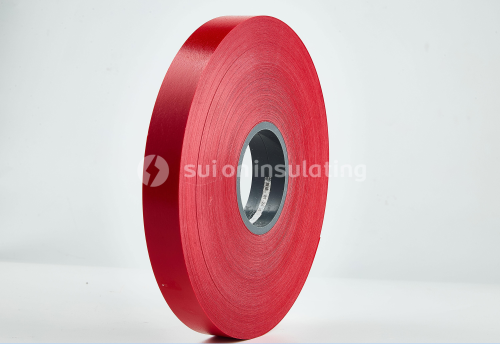
Soflex® BT24452 is what we offer for applications requiring flexible composite insulation. It is a polyester film and polyester-fiber nonwoven soft composite material impregnated with Class F epoxy resin after semi-curing. It is suitable for low voltage interlayer insulation of cast-in epoxy transformers, as well as inter-slot insulation and turn-to-turn insulation of F-grade motors and electrical appliances.
Its specified applications include low-voltage interlayer insulation in cast-in-epoxy transformers, as well as inter-slot insulation and turn-to-turn insulation in F-grade motors and electrical appliances. This makes BT24452 relevant when OEM engineers need a flexible composite material for defined insulation locations.
The product’s semi-cured epoxy structure is also important from a manufacturing perspective. For motor OEMs, insulation materials must be considered not only for their electrical function but also for how they integrate into assembly and subsequent processing. Material compatibility with the production process can influence consistency and manufacturing efficiency.
Why Flexibility Matters in Motor Manufacturing
Motor insulation frequently needs to conform to compact geometries around windings and other components. Flexible materials can be advantageous where the insulation must follow a component’s shape without introducing unnecessary bulk.
However, flexibility should not be evaluated in isolation. OEM engineers should consider dielectric requirements, temperature class, mechanical stresses, thickness, dimensional tolerances, winding configuration, and the intended manufacturing process together.
Sui On’s broader processing capabilities include slitting, lamination, forming, stamping, coating, and other processing services. Our published capabilities include slitting widths from 2.0 mm to 2000 mm and slitting thicknesses from 0.012 mm to 6 mm, while lamination covers composite products from 0.08 mm to 1.4 mm.
Selecting Electrical Insulation Material Suppliers
For motor OEMs, choosing reliable electrical insulation material suppliers involves more than comparing individual product prices. Consistent quality, technical support, processing capabilities, documentation, and application experience can all affect the procurement decision.
A supplier should be able to help engineers identify whether a material is appropriate for slot insulation, turn-to-turn insulation, phase separation, lead protection, or another application. The supplier should also provide product information that allows the OEM’s engineering team to verify compatibility with the intended insulation system.
We support this approach through a portfolio covering composite papers, aramid insulation, polyimide films, specialty films, PEEK, sleeves, and other insulation products. This enables us to address different components within a motor rather than treating insulation as an isolated material purchase.
Supporting OEM Requirements Beyond the Material
Motor OEMs increasingly need suppliers capable of supporting changing electrical and manufacturing requirements. New-energy drive systems, for example, are creating additional insulation challenges involving higher voltages, faster motor operation, thermal management, and compatibility with cooling environments.
Sui On’s vehicle-drive-system solutions include insulation materials for slot, turn-to-turn, and phase-to-phase applications. Our portfolio also includes materials intended for demanding 800V motor environments where partial-discharge resistance and compatibility with cooling media can become important considerations.
Quality systems are another consideration for OEM procurement. Sui On states that its manufacturing operations are certified to ISO 9001, ISO 14001, and IATF 16949 standards, supporting quality, environmental, and automotive manufacturing requirements.
Building a More Reliable Motor Insulation System
For motor OEMs, reliable insulation begins with understanding the operating conditions and the function of every insulation component. A material that works well for one position may not be the right choice for another because electrical, thermal, mechanical, and processing requirements can differ.
At Sui On Insulating, we approach Sui On electrical insulation as a system rather than simply a product category. From Soflex® BT24452 for specified F-grade inter-slot and turn-to-turn applications to our broader portfolio of composite, aramid, film, and engineered insulation materials, we help OEMs evaluate options according to their motor designs.
For procurement and engineering teams comparing electrical insulation material suppliers, this application-focused approach can make material selection more practical. By connecting material characteristics with actual motor requirements, we aim to support consistent manufacturing, dependable insulation performance, and the development of motors suited to demanding operating environments.